
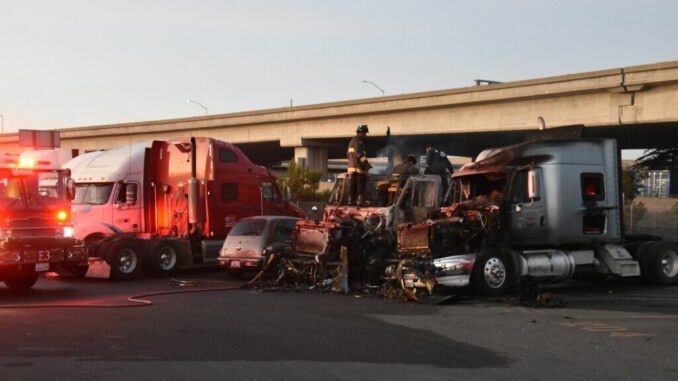
Charlotte’s position as a major logistics and distribution hub means commercial trucks are a constant presence on local highways, from I-77 and I-85 to the busy interchanges surrounding the city. That heavy truck traffic brings real risk, and when a collision with a large commercial vehicle occurs, the resulting injuries are often far more severe than those from a typical car accident.
Truck Traffic Through Charlotte
Charlotte’s role as a distribution center for the Southeast means a significant volume of freight passes through the region daily, with many trucking companies using the city as a hub connecting routes throughout the Carolinas and beyond. According to the Insurance Institute for Highway Safety, crashes involving large trucks are disproportionately likely to result in serious or fatal injuries, largely due to the substantial size and weight difference between commercial trucks and passenger vehicles.
This freight volume, combined with Charlotte’s ongoing population growth and increasingly congested roadways, has made truck accidents a persistent concern for local drivers, particularly during peak commuting hours when traffic density is highest throughout the metro area.
Why These Cases Involve Multiple Parties
Truck accident claims are often more complicated than standard car accident cases because liability can extend beyond the driver alone. Trucking companies, cargo loading companies, and even parts manufacturers can potentially share responsibility depending on what caused the crash. Federal regulations governing driver hours, vehicle maintenance, and cargo securement add another layer of complexity, since violations of these rules can serve as evidence of negligence in a resulting claim.
“People are sometimes surprised at how many different parties can be involved in a single truck accident case,” said the Charlotte truck accident attorney at Shane Smith Law. “Identifying every responsible party early on is often what separates a fair settlement from one that leaves a victim covering costs that someone else should be responsible for.”
Steps to Protect a Claim
Following a truck accident, seeking prompt medical care is essential, both because injuries from these collisions can be severe and because early treatment creates documentation connecting injuries directly to the crash. According to information published by the City of Charlotte, the city has continued to invest in road safety improvements at high traffic corridors, though drivers should still expect ongoing congestion and construction in many areas that can contribute to accident risk.
Gathering evidence quickly matters significantly in truck accident cases, since trucking companies often have investigators on scene within hours, working to protect their own interests. Requesting that evidence such as electronic logging device data and maintenance records be preserved, ideally through an attorney’s formal request, can prevent important documentation from being lost or destroyed before a case moves forward.
Deadlines and Legal Considerations
North Carolina generally allows three years from the date of an accident to file a personal injury lawsuit, giving injured victims a defined window to pursue compensation if a fair settlement cannot be reached through negotiation. However, North Carolina also follows a contributory negligence rule, one of the stricter fault standards used in the country, meaning a victim found even minimally at fault for an accident can potentially be barred from recovering any compensation at all.
This strict standard makes it particularly important for truck accident victims in Charlotte to work with someone who understands how to build a case that clearly establishes the trucking company or driver’s fault, since even a small shift in how blame is assigned can significantly affect the outcome of a claim.
For Charlotte area drivers involved in a truck accident, understanding the complexity of these cases, from the multiple parties potentially involved to North Carolina’s strict fault rules, helps set realistic expectations and underscores the importance of gathering strong evidence from the very beginning.
Nighttime driving conditions add another layer of risk on Charlotte’s busiest freight corridors, since reduced visibility combined with driver fatigue among long haul truckers can contribute to serious accidents during overnight hours. Federal regulations limit how many consecutive hours a commercial driver can operate before requiring rest, and violations of these hour of service rules often become an important focus of investigation when a nighttime truck accident results in serious injury.
Rear underride accidents, where a passenger vehicle collides with the back of a truck and slides partially underneath the trailer, represent one of the more severe types of truck accidents seen on Charlotte area highways. These crashes often result in catastrophic injuries due to the mismatch in vehicle heights, and questions about whether a trailer’s underride guard met current safety standards can become an important part of investigating liability in these particularly serious cases.
Weather related hazards, including sudden rain and reduced visibility common throughout the Charlotte region, also contribute to truck accident risk, particularly given the longer stopping distances required for fully loaded commercial vehicles. Trucking companies are generally expected to account for these conditions through appropriate driver training and safe operating practices, and a failure to adjust for known weather risks can factor into establishing negligence after a serious crash.
Leave a Reply