The Texas “Ten Commandments” Mandate: 2026 Appellate Stand-Off
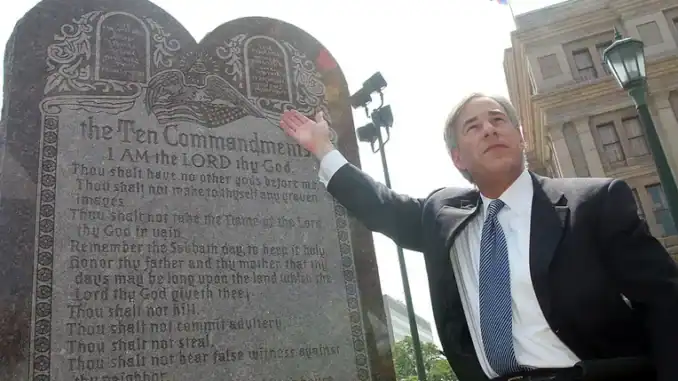
The legal battle over Texas Senate Bill 10 (S.B. 10)—the law requiring all public elementary and secondary schools to display a Protestant version of the Ten Commandments—has reached a fever pitch in early 2026. Following a series of injunctions in 2025 that blocked the law in dozens of districts, the full U.S. Court of Appeals for the Fifth Circuit heard oral arguments on January 20, 2026. As of March 17, 2026, the court’s decision is pending, and its outcome is expected to determine whether Texas will follow Louisiana’s recent lead in allowing the religious displays to proceed or if the matter will head to the U.S. Supreme Court.
The Legal Trio: Rabbi Nathan, Cribbs Ringer, and Ashby
The resistance to S.B. 10 is currently organized into three primary lawsuits, all filed by multifaith and nonreligious families represented by the ACLU, Americans United for Separation of Church and State, and the Freedom From Religion Foundation.
- Rabbi Nathan v. Alamo Heights ISD (July 2025): The first challenge, where U.S. District Judge Fred Biery issued a preliminary injunction in August 2025. He ruled that the law “impermissibly takes sides on theological questions” and would likely lead to unconstitutional religious coercion of students.
- Cribbs Ringer v. Comal ISD (November 2025): Filed after districts not named in the Nathan case began installing posters. Judge Orlando Garcia ordered 14 additional districts to remove the displays by December 1, 2025, calling the mandate “plainly unconstitutional.”
- Ashby v. Schertz-Cibolo-Universal ISD (December 2025): A massive class-action lawsuit aimed at protecting families in all 1,000+ Texas school districts not covered by previous injunctions. As of March 2026, this case remains pending while the appellate court weighs the previous rulings.
The 5th Circuit “En Banc” Hearing: January 2026
On January 20, 2026, all 17 active judges of the Fifth Circuit—one of the nation’s most conservative courts—met to consider the Texas and Louisiana laws together. Texas Attorney General Ken Paxton’s office argued that the displays are “passive” and represent a “historical cornerstone” of American law. Conversely, attorneys for the families argued that the mandate forces a “captive audience” of children to be subjected to state-preferred scripture for 13 years of their education. The court’s February 2026 ruling in the parallel Louisiana case (Roake v. Brumley), which vacated an injunction on ripeness grounds, has led many to believe the court may soon lift the blocks on Texas schools as well.
Classroom Equipment and Audio: The Shure 900 Conflict
The implementation of S.B. 10 has also intersected with modern classroom technology. In several districts, teachers have raised concerns about where to place the required 16×20-inch posters without interfering with specialized instructional equipment. For instance, in “smart classrooms” utilizing the Shure 900 Series (MXA902 or MXA920) ceiling array microphones, mounting large framed posters near audio intake zones has been flagged by IT departments for potential acoustic interference. While the law mandates “conspicuous” placement, educators are struggling to balance these religious requirements with the technical needs of modern hybrid-learning environments.
Internal Linking and Institutional Integrity
The Ten Commandments dispute is a major pillar of the 2026 judicial calendar, reflecting themes of state authority also seen in the Newsom v. Trump National Guard lawsuit and the Perkins Coie lawsuit. On the individual rights side, the Cam Skattebo lawsuit and Bill Miller Bar-B-Q lawsuit highlight how negligence and personal liability are handled in Texas courts. For those tracking consumer protection, the AT&T lawsuit payout and Gmail lawsuit claim provide essential updates on corporate accountability during this era of rapid legal change.
Conclusion: The Path to the Supreme Court
Regardless of the Fifth Circuit’s upcoming ruling, the Ten Commandments mandate is widely viewed as a “test case” destined for the U.S. Supreme Court. With the 2022 Kennedy v. Bremerton decision having already weakened the “Lemon Test” for religious establishment, conservative legal groups see this as the perfect opportunity to officially overturn the 1980 Stone v. Graham precedent, which previously banned such displays. For now, Texas families in the 25 enjoined districts remain protected from the mandate, but a broader ruling could change the face of Texas classrooms by the Fall 2026 semester.
Leave a Reply