
Houston property owners, whether they operate a retail store, apartment complex, or office building, carry legal responsibility for keeping their premises reasonably safe for visitors. When that responsibility isn’t met and someone is injured in a fall, Texas law provides an established framework for how these claims are evaluated, and understanding that framework benefits property owners just as much as injured visitors.
A Property Owner’s Duty of Care in Texas
Texas premises liability law generally requires property owners to inspect for hazards, address known dangers within a reasonable time, and provide adequate warning when an immediate fix isn’t possible. According to the Occupational Safety and Health Administration, slip, trip, and fall hazards remain among the most common causes of workplace and public injury, underscoring why routine inspection and maintenance matter so much for any property that welcomes visitors.
The specific duty a property owner owes can depend on why someone is on the property in the first place, with customers and tenants generally owed the highest standard of care, while trespassers are owed a more limited duty under Texas law.
How Slip and Fall Claims Typically Unfold
When a visitor is injured on a property, the claims process generally begins with the injured party reporting the incident and, ideally, documenting the hazard through photographs before it can be repaired or removed. From there, the property owner’s insurance carrier typically investigates the claim, reviewing any available surveillance footage, maintenance logs, and incident reports to determine whether the property owner had knowledge of the hazard.
“Property owners are sometimes surprised at how much documentation a claim actually requires on both sides,” explained the Houston slip and fall lawyer from The Insurance Outlaw. “It’s not just about whether someone fell. It comes down to what the property owner knew, or should have known, and what they did about it.”
Common Defenses Property Owners Raise
Property owners and their insurers frequently raise several defenses in response to a slip and fall claim. One of the most common is arguing that the hazard was open and obvious, meaning a reasonably attentive visitor should have noticed and avoided it. Another frequent defense involves comparative negligence, where the property owner argues the injured visitor bears some responsibility for the fall, such as by not watching where they were walking or ignoring a posted warning sign.
Under Texas’s modified comparative negligence rule, an injured visitor can still recover compensation as long as they are found less than fifty one percent at fault, though their compensation is reduced by their assigned percentage of responsibility. This standard means that even a partially successful defense doesn’t necessarily eliminate a property owner’s liability entirely.
Reducing Risk Before an Incident Occurs
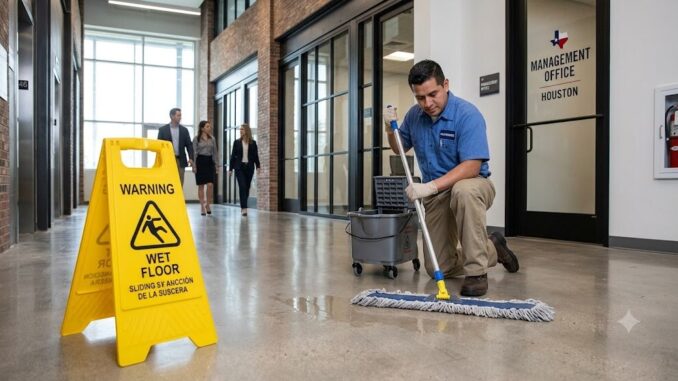
The most effective way for Houston property owners to manage slip and fall risk is through consistent, documented maintenance practices. Regular inspection schedules, promptly addressing spills or hazards, and maintaining clear signage during cleaning or repair work all help demonstrate that a property owner acted reasonably, which can significantly affect the outcome of a claim if an incident does occur.
According to data compiled by the National Floor Safety Institute, a meaningful share of slip and fall incidents nationwide occur in retail and food service environments, often tied to wet floors, uneven surfaces, or inadequate lighting, all of which are generally preventable through routine attention and maintenance.
Keeping thorough records of inspections and maintenance, including dated logs and photographs, gives property owners a stronger position if a claim is filed, since this documentation can help demonstrate that reasonable care was taken even if an isolated incident occurred despite those efforts.
For Houston property owners, understanding both the legal duty they carry and the practical steps that reduce risk provides a clearer path toward avoiding disputes altogether, while also positioning them to respond effectively if a slip and fall claim does arise on their property.
Seasonal considerations also matter for Houston properties, since heavy rainfall throughout much of the year creates recurring hazards around entryways, parking lots, and outdoor walkways. Property owners who proactively address drainage issues, install slip resistant flooring in high risk areas, and maintain covered walkways where practical often see fewer incidents than those who only respond to hazards after a complaint or an injury has already occurred.
Commercial leases can also complicate who bears responsibility for a given hazard, particularly in shopping centers or office complexes with multiple tenants sharing common areas. Determining whether a landlord or an individual tenant is responsible for a specific hazard, such as a broken step in a shared hallway or a poorly lit parking area, often depends on the specific terms of the lease agreement and which party had practical control over maintaining that portion of the property.
Insurance coverage also plays a significant role in how these claims are ultimately resolved, since most commercial property owners carry general liability insurance specifically intended to cover this type of claim. Understanding policy limits and any exclusions that might apply becomes an important part of the process for both the property owner managing risk and any injured party seeking fair compensation for their losses.
Leave a Reply