
Houston’s mix of retail centers, apartment complexes, and busy commercial districts means residents and visitors encounter a wide variety of properties every day, and not all of them are kept in safe condition. When a hazard on someone else’s property causes an injury, Texas law gives injured visitors a path to hold property owners accountable, though understanding how these premises liability claims work is essential before pursuing one.
Understanding Premises Liability in Texas
Premises liability is a legal doctrine holding that property owners and occupiers have a duty to maintain reasonably safe conditions for people who come onto their property. According to Wikipedia’s overview of premises liability, the specific duty owed can vary depending on the visitor’s legal status, whether they are an invitee, licensee, or trespasser, with property owners generally owing the highest duty of care to invitees such as customers or tenants.
In Texas, this means a store, apartment complex, or office building generally must inspect for hazards, repair known dangers within a reasonable time, or warn visitors about conditions that cannot be immediately fixed. Failure to do so can expose the property owner to liability if someone is injured as a result of the hazard.
Common Hazards Around Houston Properties
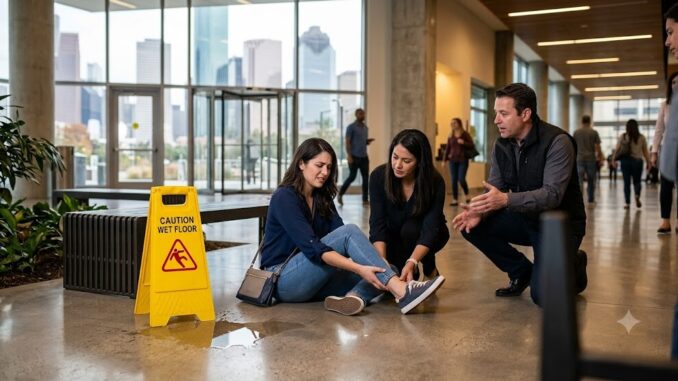
Houston’s humid climate and frequent heavy rainfall create particular premises hazards, including slick tile floors in retail entryways, poorly maintained parking lots with standing water, and slippery surfaces around pools and outdoor walkways. Beyond weather related hazards, common premises liability issues in the area include inadequate lighting in stairwells and parking garages, broken handrails, uneven walking surfaces, and negligent security in apartment complexes or commercial properties with a history of criminal activity.
According to the premises liability attorney at Haque Law, many injured visitors are surprised to learn how much documentation these claims actually require. “It isn’t enough to show you were hurt on someone’s property,” the attorney explained. “You have to show the property owner knew about the hazard, or should have known, and failed to address it within a reasonable amount of time.”
What Injured Visitors Need to Prove
Under Texas premises liability law, an injured visitor generally must show that the property owner knew, or reasonably should have known, about a dangerous condition and failed to fix it or provide adequate warning. This standard means an injury on its own does not automatically establish liability, since the property owner must have had actual or constructive knowledge of the hazard before the incident occurred.
According to data compiled by the National Safety Council, falls remain one of the leading causes of unintentional injury nationwide, and slip and fall cases frequently turn on whether a hazard existed long enough that a reasonably attentive property owner should have discovered and addressed it before someone was hurt.
Comparative negligence also applies in Texas premises cases, meaning a property owner’s insurer may argue the injured visitor was partly responsible, for example by not watching where they were walking or ignoring a posted warning sign. As with other Texas injury claims, an injured person can still recover damages as long as they are found less than fifty one percent at fault for the incident.
Steps to Take After a Premises Injury
Anyone injured on someone else’s property should report the incident to management or the property owner immediately and request that an incident report be created. Photographing the hazard before it can be cleaned up or repaired is one of the most important steps an injured visitor can take, since conditions like spills or debris are often addressed within minutes of being reported.
Seeking prompt medical attention both protects health and creates a documented record connecting the injury to the specific incident. Because property owners and their insurers often move quickly to repair a hazard once notified, which can eliminate physical evidence, gathering photos, witness names, and a copy of any incident report as soon as possible helps preserve the details a claim may later depend on heavily.
Houston’s dense mix of shopping centers, high rise offices, and residential complexes means premises liability claims arise in a wide range of settings, and understanding both a property owner’s duty of care and the type of evidence needed to prove a claim gives injured visitors a much stronger foundation for pursuing fair compensation for their injuries after an accident.
Apartment complexes present their own particular set of premises liability concerns beyond the typical slip and fall scenario. Broken stairwell railings, malfunctioning security gates, poorly lit parking areas, and inadequate security in complexes with a documented history of criminal activity can all give rise to a claim if a tenant or guest is injured as a result. Texas courts have recognized that landlords generally owe a duty to address hazards they know about or should reasonably discover through routine property management.
Commercial properties, including grocery stores and shopping centers, face similar obligations but often deal with higher volumes of foot traffic, which can make it harder to argue that a hazard was not discovered within a reasonable time. Store surveillance footage frequently becomes important evidence in these cases, since it can show how long a spill or other hazard was present before an injury occurred, information that is not always available in smaller residential settings.
Because Texas law requires injured claimants to act within a limited window of time, and because evidence such as surveillance footage is sometimes only retained for a matter of weeks, injured visitors benefit from moving quickly to preserve records and documentation rather than waiting until a claim is further along.
Leave a Reply